
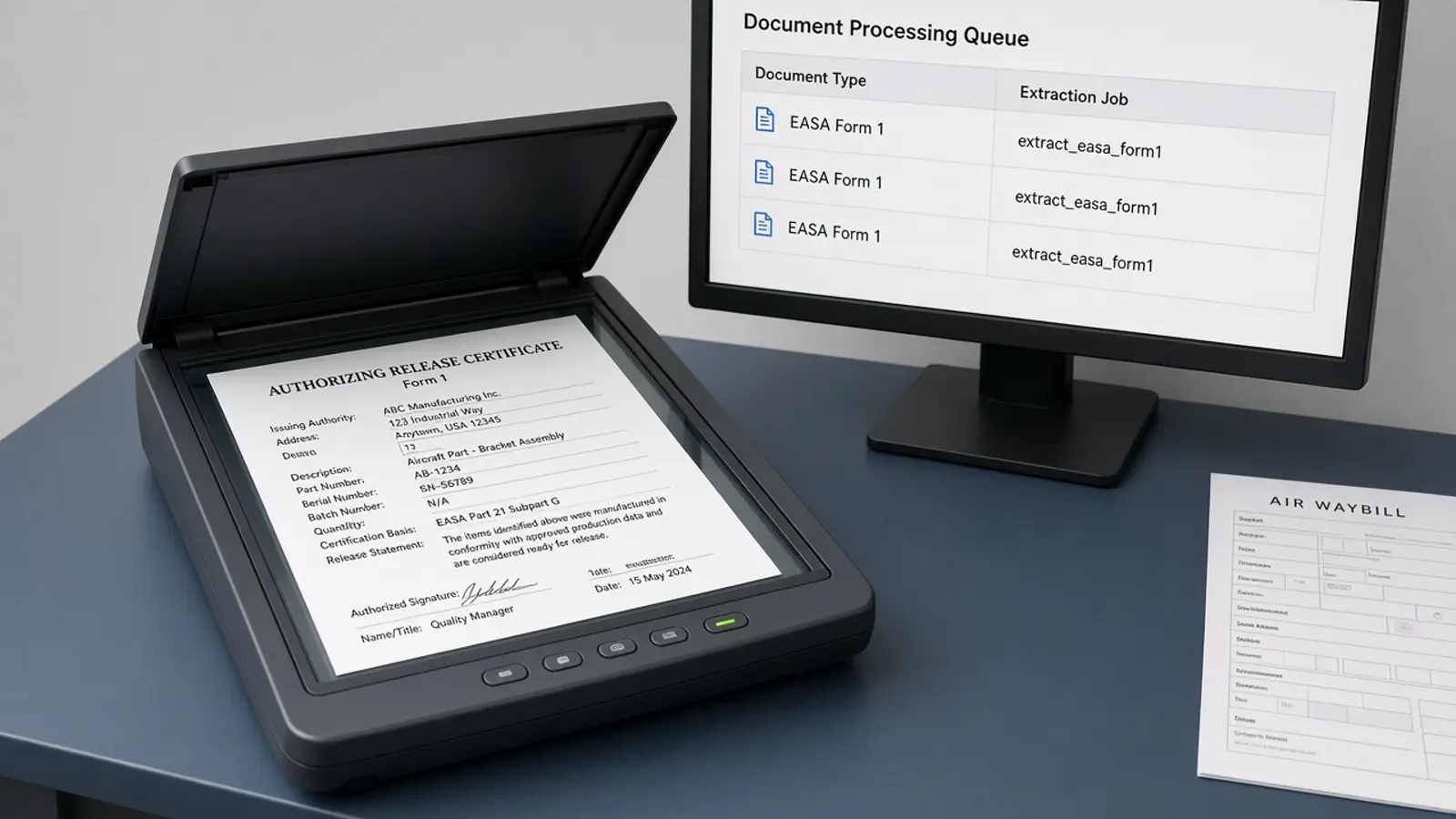
An aircraft-parts shipment carries up to seven documents, and a broker or forwarder does not need to automate all of them at once. Rank them by three questions: how often does it arrive, is it already structured data somewhere, and what does a wrong value cost?
TL;DR. Start with the commercial invoice (every shipment, feeds the declaration) and the release certificate (EASA Form 1, FAA 8130-3: the identity of the part, and the document generic invoice OCR cannot read). The AWB is often already electronic from the carrier. Packing list, certificate of origin, transit document and dangerous goods declaration apply only to some movements. Doana reads invoice lines and certificates in its standard product, and extracts AWBs, packing lists, origin certificates and T1 documents in custom pipelines built on a client's own files.
How do the seven rank?
| # | Document | Frequency | Already structured? | Cost of a wrong value |
|---|---|---|---|---|
| 1 | Commercial invoice | Every commercial import | Rarely; PDF from the seller | Wrong value, origin or classification on the declaration |
| 2 | Release certificate (EASA Form 1, FAA 8130-3, TCCA Form One) | Every ARC-class part | Rarely; scan or PDF | Part quarantined, or a P/N that contradicts the invoice |
| 3 | AWB / HAWB | Every air shipment | Often, as carrier EDI | Pieces or weight mismatch at arrival |
| 4 | Packing list | Most multi-piece shipments | Rarely | Count mismatch against invoice and AWB |
| 5 | Certificate of origin | Only when claiming preference or when required | Rarely | Lost preference or a query |
| 6 | Transit document (T1, TAD) | Only under transit | Yes, NCTS | Transit not discharged |
| 7 | Dangerous goods declaration | Only DG shipments | Rarely | Offload or refusal |
The first two arrive on almost every aircraft-parts import and are almost never structured. That is where retyping time goes.
Why does generic invoice OCR miss the Form 1?
A generic document OCR or IDP tool is trained on invoices, purchase orders and bills of lading. It can read a Form 1 as text, but it does not know that Block 8 is the part number, Block 10 a list of serials, or that Blocks 13 and 14 are two release statements of which only one is signed. Some tools add a Form 1 template with a handful of fields. The ones that stop at part number, serial and date leave out Block 11 (status), Block 12 (remarks) and the release blocks, which are what receiving decides on.
US entry automation around CBP Form 7501, or Canadian CARM accounting, works from invoice data. The Form 1 never goes into those declarations. It matters when its part number or description contradicts the invoice line, which is a question the broker would rather catch before filing. See the Form 1, invoice and AWB mismatch guide.
Why is the AWB lower on the list?
Because the carrier often has it as structured data already. A forwarder with carrier EDI gets pieces, weight and routing without OCR. Reading the AWB PDF makes sense when that feed does not exist, or for the house bill from a smaller forwarder.
What does Doana read today?
| Document | Doana |
|---|---|
| Commercial invoice | Web app: part number, HS code, quantity, total price, country of origin and weight per line |
| EASA Form 1 | Boxes 1 to 14 with confidence and page (MCP); certificate type and part numbers (web app) |
| FAA 8130-3, TCCA Form One | Certificate type and part numbers (web app) |
| AWB and HAWB, packing list, certificate of origin, T1 | In a custom extraction pipeline set up for the client, with CSV output for its customs software |
Custom pipelines start from the contact form. In the web app, invoice lines are matched to certificates by part number, so a line with no matching certificate stands out. Doana does not file declarations, classify goods on its own authority, or certify airworthiness. Details: Authorised Release Certificate OCR.
Next
Count last month's shipments by document type and note which ones someone retyped. Automate the top two first. For an aircraft-parts importer, those are likely the invoice and the release certificate.
Sources
- https://www.cbp.gov/trade/programs-administration/entry-summary/cbp-form-7501
- https://www.canada.ca/en/border-services-agency/services/carm.html
- https://taxation-customs.ec.europa.eu/customs/customs-procedures-import-and-export/customs-transit_en
- https://nanonets.com/document-ocr/authorised-release-certificate
- https://doana.ca/en/easa-form-1-automation